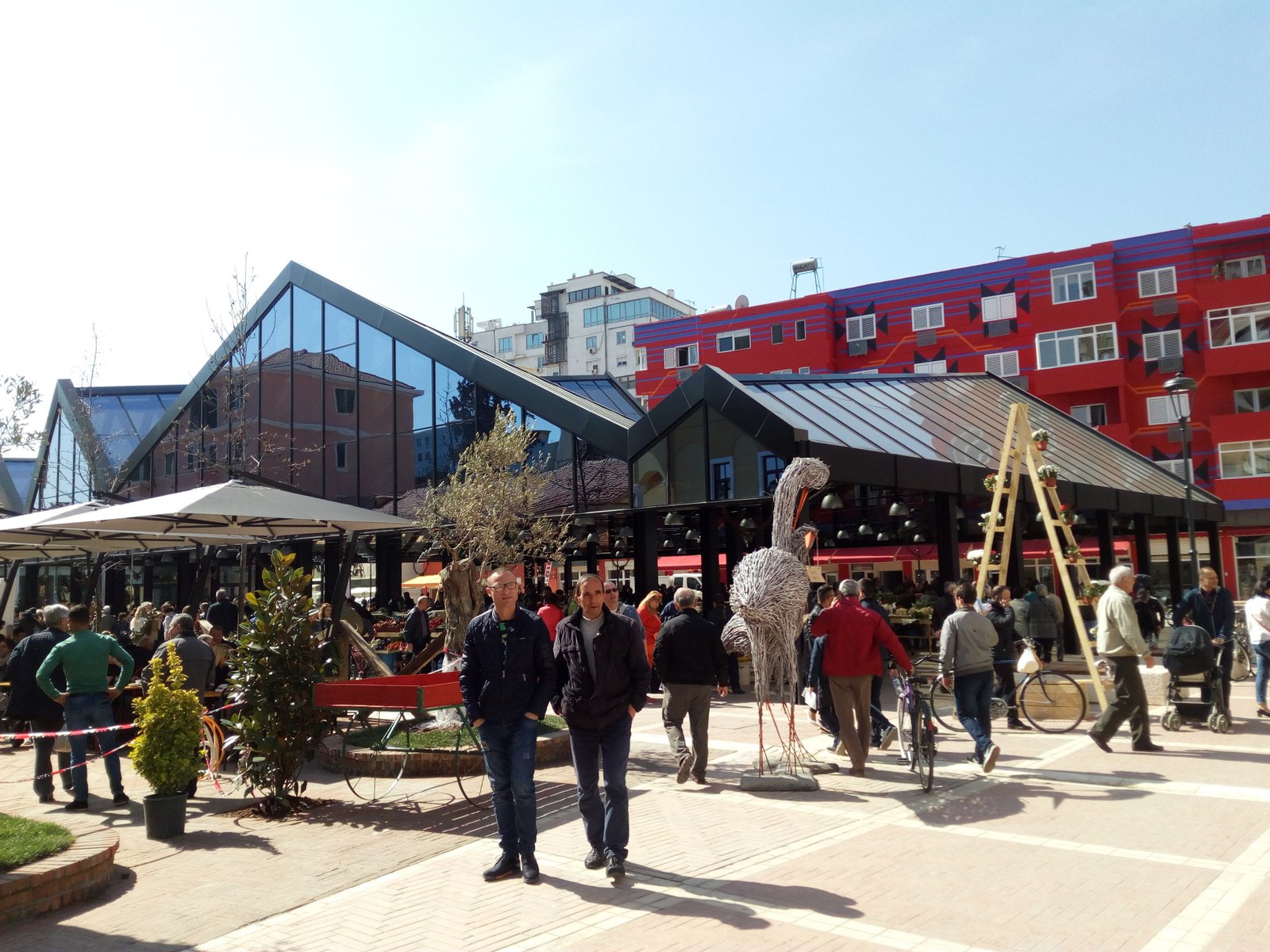
Albania punches well above its weight in the food department. The country sits at a crossroads of Mediterranean, Ottoman, and Balkan culinary traditions, and the result is a cuisine that is at once deeply familiar and genuinely surprising. You will recognise the ingredients — olive oil, lamb, yogurt, peppers, herbs — but the combinations and techniques are distinctly Albanian, shaped by centuries of highland isolation, coastal abundance, and a hospitality culture that treats feeding guests as a near-sacred obligation.
Prices are also, by any reasonable standard, absurd in the best possible way. A full restaurant meal — starter, main, dessert, local wine — rarely exceeds 1,500 ALL (around €13) per person even in central Tirana. On the coast, a whole grilled sea bass with salad and bread for two people can come in under 2,000 ALL. This guide covers the dishes you absolutely cannot leave without trying, from the national dish to the street-food staples, the desserts, and the drinks.
Albanian dishes at a glance
Not sure where to start? The chart below gives a quick reference for the key dishes, their region of origin, category, and what you should expect to pay at a typical Albanian restaurant or street stall.
The essential dishes
Tavë Kosi — Albania's national dish

If you eat only one Albanian dish, make it tavë kosi. Albania's national dish is deceptively simple — slow-baked lamb and rice covered in a rich, egg-thickened yogurt sauce — but the result is deeply satisfying in a way that is hard to articulate to someone who has not tried it. The key is Albanian yogurt, which is thicker and more intensely flavoured than anything sold in Western supermarkets, and the lamb, which in good versions is genuinely free-range and grass-fed.
The dish is particularly associated with Elbasan, a city in central Albania where it has been made for centuries — you will see a slight regional variant called tavë Elbasani on menus, which differs mainly in technique. In Tirana, virtually every traditional restaurant serves tavë kosi, and it is the dish most Albanian mothers will insist you try if you are ever invited to a home meal. Budget 600–900 ALL at a mid-range restaurant. It is worth every lek.
Byrek — flaky pastry for every occasion

Byrek is everywhere in Albania, and it is glorious. This flaky, filo-style pastry comes in a range of fillings — spinach and feta (me spinaq), minced meat (me mish), or plain cheese (me djathë) being the three most common — and is sold from dedicated byrek bakeries for 50–100 ALL a slice. That is roughly 45–90 euro cents. A family of four can breakfast on byrek for under €3.
Quality varies widely. The best byrek has paper-thin layers that shatter slightly when you bite through them, a filling that is moist but not wet, and enough olive oil to give the whole thing a faint golden richness. The worst is a stodgy, dense slab that tastes mainly of dough. Seek out bakeries where the byrek is being made fresh and sold warm — you will be able to smell them from the street. Dua Lipa and Rita Ora have both publicly professed their love for Albanian byrek, which should settle any remaining doubts.
Fërgësë — Tirana's signature clay pot

Ask any Tirana local what the definitive dish of their city is and the answer will almost always be fërgësë. This hearty preparation combines roasted green and red peppers, skinned tomatoes, onions, and gjizë — a mild Albanian cottage cheese that dissolves into a creamy, tangy sauce — all cooked together in a clay pot on the stove before finishing in the oven. Traditional versions include lamb offal or liver, which is considered the more authentic Tirana preparation and gives the dish a deeply savoury richness. Vegetarian versions (fërgësë verore) omit the meat entirely and are just as satisfying.
The dish arrives at the table bubbling in its clay pot, scooped up with bread, and best accompanied by an Albanian salad of tomatoes, cucumber, peppers, and olives dressed with olive oil and a little vinegar. Budget 500–800 ALL at a traditional restaurant.
Qofte — grilled meatballs on every corner

Qofte are Albania's answer to the universal human desire to eat something grilled, small, and meaty with minimal fuss. These flattened meatball patties or small sausage shapes are made from minced lamb or beef mixed with herbs, garlic, and onion, grilled over charcoal, and served with bread, a simple salad, and ajvar — the roasted pepper relish that appears on every Albanian table as automatically as salt and pepper. Dedicated qofteri shops exist throughout the country, often paired with a beer selection. A plate of six qofte with sides runs 300–500 ALL.
Flija — a labour of love from the north

Flija is not something you order at a restaurant — it is something you are invited to share. This extraordinary layered pastry from northern Albania and Kosovo is made by building up thin crepe-like layers of batter, each cooked beneath a metal lid placed over open embers, building up a fat, golden disc that is cut into wedges and served with sour cream, honey, or jam. Making flija properly takes two to three hours of patient tending. It appears at weddings, celebrations, and large family gatherings, and being served flija is a genuine honour. If a local family offers you some, say yes immediately.
Sufllaqe — the Albanian street food staple
Albania's answer to the doner kebab, sufllaqe is a gyros-style wrap of rotisserie-cooked meat — chicken, pork, or lamb — sliced and folded into thin bread with tomatoes, onions, and a yogurt or garlic sauce. Every town in Albania has at least one sufllaqe stand, and the better ones are genuinely excellent late-night eating. Prices run 150–300 ALL. The name itself reflects the word's journey through Turkish and Greek culinary cultures into Albanian street food.
In the north, particularly in the mountain regions around Shkodër, you will also find pispili — a dense, satisfying cornbread that is a staple of highland cooking, often served alongside spit-roasted lamb at village celebrations and increasingly finding its way onto the menus of rustic restaurants in Tirana.
Seafood on the Albanian coast

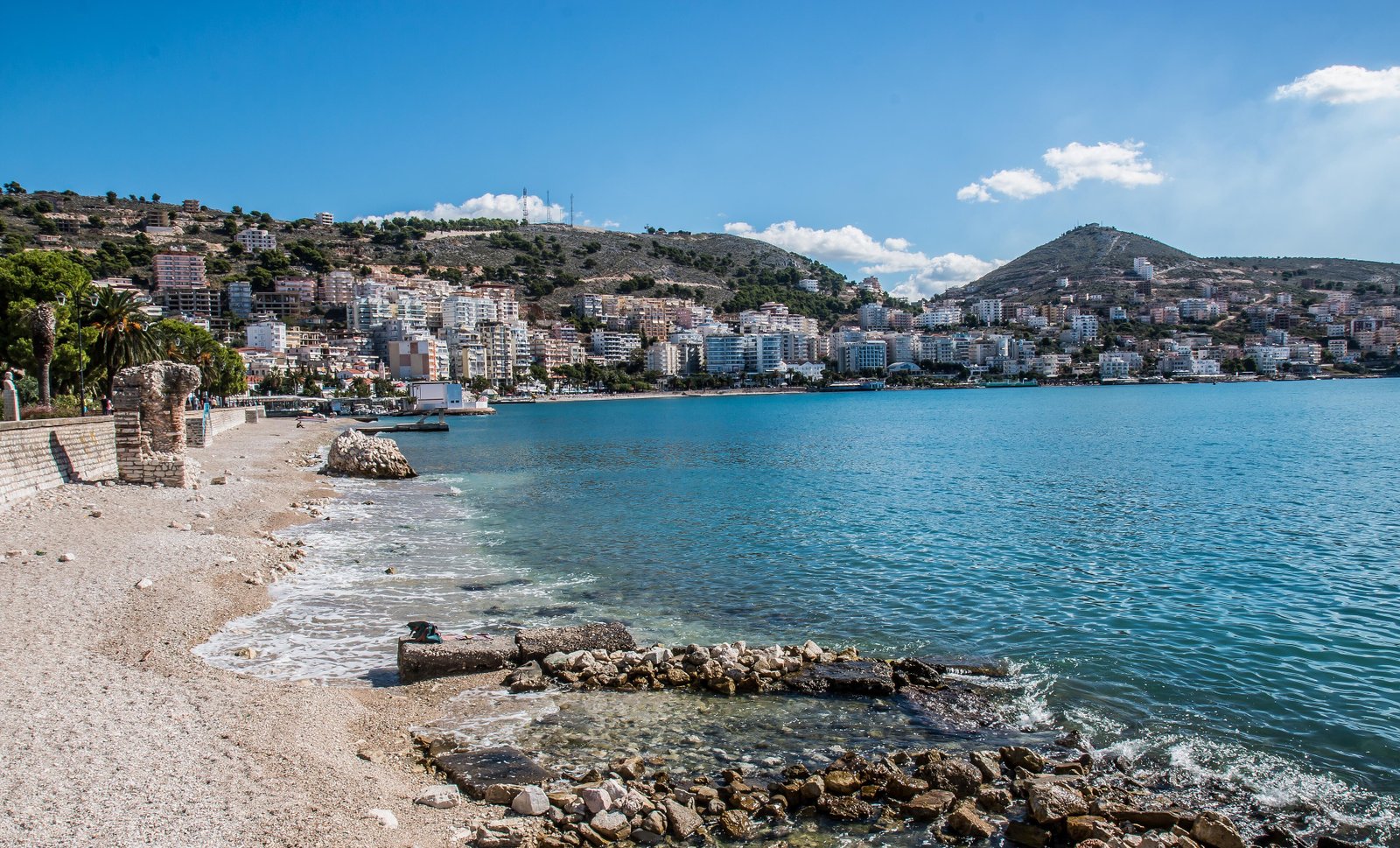
The Albanian coast — both the Adriatic in the west and the Ionian in the south — produces outstanding seafood, and coastal Albanian cooking treats it with exactly the right amount of respect, which is to say: as little intervention as possible. The default order at any seaside taverna is a whole grilled sea bass (levrek) or gilt-head bream (koce), cooked over wood coals and dressed with nothing but lemon juice and virgin olive oil. A whole fish for one person runs 600–1,200 ALL depending on size and location.
Mussels are farmed locally along the coast and appear on menus in summer — fried (midhje të skuqura) or steamed in white wine and garlic (midhje në avull). Octopus grilled over charcoal, a distinctly Ionian preparation, is another not-to-miss order. Scampi and calamari round out the typical coastal menu. A full seafood dinner for two with salad, bread, and local wine from the coast at Sarandë or Vlorë typically runs 2,000–4,000 ALL — roughly €18–37, a fraction of equivalent meals in Greece or Italy across the water.
Desserts and sweet treats
Trilece is Albania's most popular café dessert and one of the country's genuine culinary claims to fame. An Albanian adaptation of the Latin American tres leches cake, trilece is a sponge soaked in three milks — cow, goat, and water buffalo — producing a texture so moist and tender it verges on pudding. Albania is widely credited as the country that introduced tres leches to the Eastern Mediterranean and Turkey, apparently via the popularity of Latin American telenovelas in the 1990s, when local chefs reverse-engineered the dessert from what they saw on screen. You will find trilece in virtually every café in Albania for 150–250 ALL a slice.
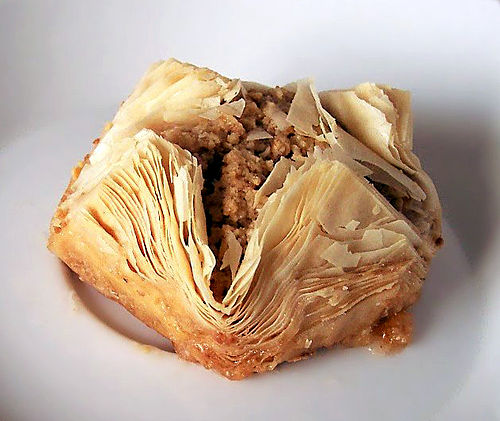
Petulla is the Albanian breakfast indulgence: rounds of fried dough, light and puffy when fresh, dusted with powdered sugar or served with gjizë and raspberry jam. Street stalls in old bazaar areas sell them hot. Baklava appears at every religious holiday — Muslim, Catholic, and Orthodox alike, reflecting Albania's remarkable tradition of religious coexistence — made with walnuts or hazelnuts in honey syrup. And ballokume, the crumbly corn-flour cookie from Elbasan, is baked every year for Summer Day (March 14) and has become something of a national identity food.
Drinks: raki, coffee and beyond

Raki is the national spirit — a grape brandy made at home by virtually every Albanian family that has ever owned a vine. It is clear, potent (typically 40–50% ABV), and offered to guests as a matter of course from the moment you step through the door. Refusing is possible but slightly rude; accepting and sipping slowly is the correct protocol. Raki rigoni, made from white oregano in the south, is a particularly prized regional variant.
For something more formal, Konjak Skanderbeg is Albania's well-regarded cognac brand, aged in oak barrels and named after the 15th-century national hero Gjergj Kastrioti Skanderbeg. It is widely available in restaurants and makes an excellent souvenir. Albanian wine is also underrated — the country has been producing wine for 6,000 years, and local varieties including Shesh i Zi (red) and Shesh i Bardhë (white) are worth seeking out.
Coffee culture in Albania is serious business. Albania surpassed Spain in 2016 to become the country with the most coffee houses per capita in the world, at 654 per 100,000 inhabitants. Espresso is the default, strong and short, costing 50–80 ALL — roughly 45–75 euro cents. Turkish-style coffee (kafe turke) is also common, particularly in older cafés. The Albanian kafe functions as a social institution: a place to meet, conduct business, discuss politics, and spend several hours over a single cup. Rushing is not considered a virtue.
Food and Albanian hospitality
Understanding Albanian food means understanding mikpritja — hospitality — which is not merely a custom but a near-sacred obligation embedded in the medieval code of honour called besa. The traditional Albanian greeting "bukë, kripë e zemër" — bread, salt and heart — captures the philosophy precisely: to share food is to share yourself.
If you are invited to an Albanian home, you will be fed until you can eat no more, and then fed a little more. Refusing food is taken as a mild insult. Accepting enthusiastically and complimenting the cook is the right response. The expression for going to eat a meal in Albanian, për të ngrënë bukë, translates literally as "going to eat bread" — reflecting how central bread, and the act of sharing it, remains to Albanian cultural identity.
Albanian food prices: a quick comparison
Planning a budget? Here is a visual reference for what common foods and meals cost in Albanian lek (ALL) at a typical Tirana restaurant or street stall in 2026.
Practical tips for eating in Albania
Cash is king in most traditional restaurants and all street food stalls. Always carry Albanian lek. ATMs are plentiful in cities but bring enough cash when heading to smaller towns or coastal villages.
Lunch is the main meal in Albanian culture. The best food at the best prices is found at lunch, not dinner. Many Albanian families eat at home at lunch; restaurants fill up between 13:00 and 15:00. If you eat at a traditional restorant during this window, you are likely eating alongside Albanian families rather than tourists.
Vegetarians can eat well, but should be prepared to navigate. Byrek me spinaq, fërgësë verore, bean dishes (fasulle), stuffed peppers, and Albanian salad cover the menu, but meat is the default assumption and dishes described as vegetarian sometimes contain small amounts of lamb broth. Ask explicitly: "pa mish" (without meat).
Tipping is not obligatory but is appreciated. Rounding up the bill, or leaving 100–200 ALL on a mid-size meal, is appropriate. In upscale restaurants a 10% tip is normal.
Ready to find the best Albanian restaurants near you?
Browse our directory of verified restaurants across Tirana, Sarandë, Gjirokastër, and beyond.
Browse restaurants →