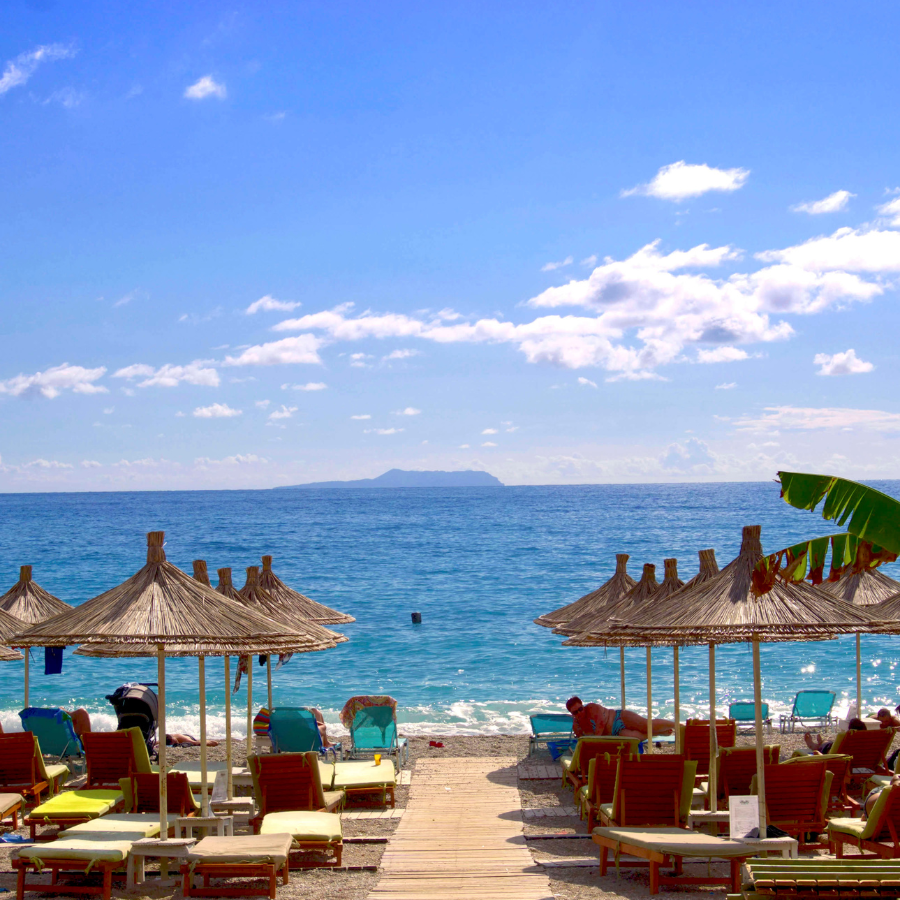
For years, European travellers seeking sun-drenched coastline and crystal-clear Ionian water crowded into the Greek islands, the Croatian Adriatic, and the Italian Amalfi Coast, accepting sky-high prices as the cost of a Mediterranean summer. Meanwhile, just across a border that most tourists never crossed, the Albanian Riviera sat largely undiscovered — its limestone cliffs plunging into water so clear you can count the pebbles five metres down, its olive-draped villages clinging to hillsides above turquoise bays.
That is changing, and it is changing fast. Budget airlines now connect Tirana's Mother Teresa International Airport to dozens of European cities. New boutique hotels and stylish beach bars have appeared in Dhermi and Ksamil. Yet the Albanian Riviera remains, for now, genuinely different from its better-known neighbours: less crowded, more affordable, and more authentically itself. This guide tells you everything you need to know to make the most of it.

Getting there from Tirana
The most common route from Tirana to the Riviera follows the SH8 road south — a journey of around 300 kilometres that passes through Fier, Vlorë, and then climbs up and over the legendary Llogara Pass before the coast reveals itself. By car the drive takes approximately four to five hours in good traffic, though you should budget extra time in summer when convoys form on the mountain pass.
If you are not driving, the most reliable public option is a direct bus from Tirana's Kombinat bus terminal to Sarandë or Vlorë. Several companies run daily departures starting from around 06:00, with journey times of roughly five hours to Sarandë. Tickets cost between 1,000 and 1,500 ALL (roughly €9–14) depending on the operator and season.
For travel between towns on the Riviera itself, furgons — shared minivans that depart when full — are the local way to get around. They run frequently between Sarandë, Ksamil, Himara, and Dhermi through the summer. Agree the fare before you get in, and don't be surprised if you share the back seat with a crate of tomatoes. Renting a car in Tirana gives you the most freedom, especially if you want to reach smaller coves that have no bus service.
The Llogara Pass: a dramatic entry into the Riviera
Whether you approach by bus or private car, the moment the road crests the Llogara Pass at 1,027 metres above sea level, you understand why people make this journey. The pine forests of the Llogara National Park part, and suddenly — below and to the south — the full sweep of the Riviera unfolds: turquoise sea, pale sand, olive groves cascading down limestone mountains to the water's edge. The panoramic view from the pass is arguably the single best vista in Albania.
Plan to stop here. There are several small restaurants and cafés at the top serving grilled lamb, byrek, and strong Albanian coffee with a view that would cost a fortune anywhere else in the Mediterranean. The descent from Llogara down the hairpin bends of the SH8 is steep and dramatic — take it slowly, keep to the inside of the lane, and watch out for oncoming vehicles cutting corners.
The beaches: north to south
The Riviera's roughly 100 kilometres of Ionian coastline contain more variety than the headline numbers suggest — from open shingle bays fringed by olive trees to tiny coves accessible only on foot or by boat. Here, travelling from north to south, are the beaches and towns you should know.
Palasë
The first significant beach you reach after descending from Llogara, Palasë is a broad pebble-and-sand bay backed by olive groves, with remarkably clear water. It carries an extraordinary footnote of history: on January 4, 48 BCE, Julius Caesar landed here with seven legions, beginning his pursuit of Pompey through the Balkans. A small plaque marks the spot. Today Palasë is pleasantly low-key — a handful of guesthouses, a few beach bars, and a beach that sees a fraction of the crowds that gather further south.

Dhermi
Dhermi is the Riviera's most celebrated village, and with good reason. The old village sits at roughly 200 metres altitude above the beach, its whitewashed stone houses and Byzantine church looking out across the Ionian towards the silhouette of Corfu. The beach below — reached by a winding road or a scrambling path — is a striking crescent of white pebbles and water that shifts through every shade of green and blue.
In recent years, Dhermi has developed the Riviera's most energetic nightlife scene. Beach clubs like Folie and Kukës Beach pump music into the summer nights, and a string of boutique hotels — some genuinely stylish, with infinity pools and excellent local wine lists — have opened to serve the growing crowd of upscale travellers. Despite all this development, the beach itself remains beautiful, and the old village above retains genuine character.

Gjipe Canyon
South of Dhermi, a narrow limestone canyon cuts through the mountains and opens directly onto a secluded pebble beach — this is Gjipe, and it is one of the most spectacular natural settings on the entire coast. Gjipe can only be reached on foot: the standard approach begins at the St. Theodore monastery and follows a hiking trail that takes around 30 to 40 minutes each way. There is no road, no car park, and no beach bar serving frozen cocktails. What you get instead is swimming in perfect silence, snorkelling over submerged rocks, and the knowledge that most visitors to the Riviera never made it here. Bring water and snacks.
Borsh
Further south, Borsh is home to something genuinely remarkable: at seven kilometres, it is the longest beach on the Ionian Sea. The scale of it is almost disorienting — a long, wide crescent of grey pebbles backed by ancient olive trees and the distant silhouette of the mountains. Because it is so large, Borsh almost never feels crowded, even in August. Facilities are modest by design: a few tavernas and small hotels, beach chairs for rent, and the kind of unhurried atmosphere that has largely been engineered out of more popular Mediterranean destinations. If you want space, peace, and outstanding swimming, Borsh deserves a full day of your attention.
Himara and Livadhi beach
Himara is the largest town on the Albanian Riviera, and it feels it — in a good way. The old castle town sits on a rocky promontory above the sea, its narrow lanes of stone houses harbouring some of the best traditional restaurants on the coast. Unlike the more self-consciously hip Dhermi, Himara has a lived-in, local feel: Albanian families on summer holiday, children playing in the streets in the evenings, kafes where old men argue over politics and drink small cups of coffee. The main beach, Livadhi, stretches north of town and is one of the more family-friendly options on the coast.

Porto Palermo
Between Himara and Sarandë, the road passes Porto Palermo bay, where an extraordinary 19th-century castle built by Ali Pasha of Ioannina occupies its own small peninsula jutting into the bay. The castle is open to visitors and worth the short detour — the views from the battlements are spectacular, and the bay below is a popular anchorage for yachts. Under communist rule, Porto Palermo also served as a submarine base, and some of the underground tunnels can still be explored.
Qeparo
Qeparo is one of the most distinctive villages on the Riviera: it exists in two distinct halves separated by altitude. The old hilltop village, perched above the coast, has the crumbling romantic beauty of a medieval settlement — stone archways, ancient churches, houses whose owners long ago left for Athens or New York. The new beach village below is lively in summer, with restaurants serving excellent fresh fish and a small shingle beach with some of the warmest water on the coast. Staying in a guesthouse in the old village and walking down to swim is one of the great simple pleasures of a Riviera holiday.
Sarandë
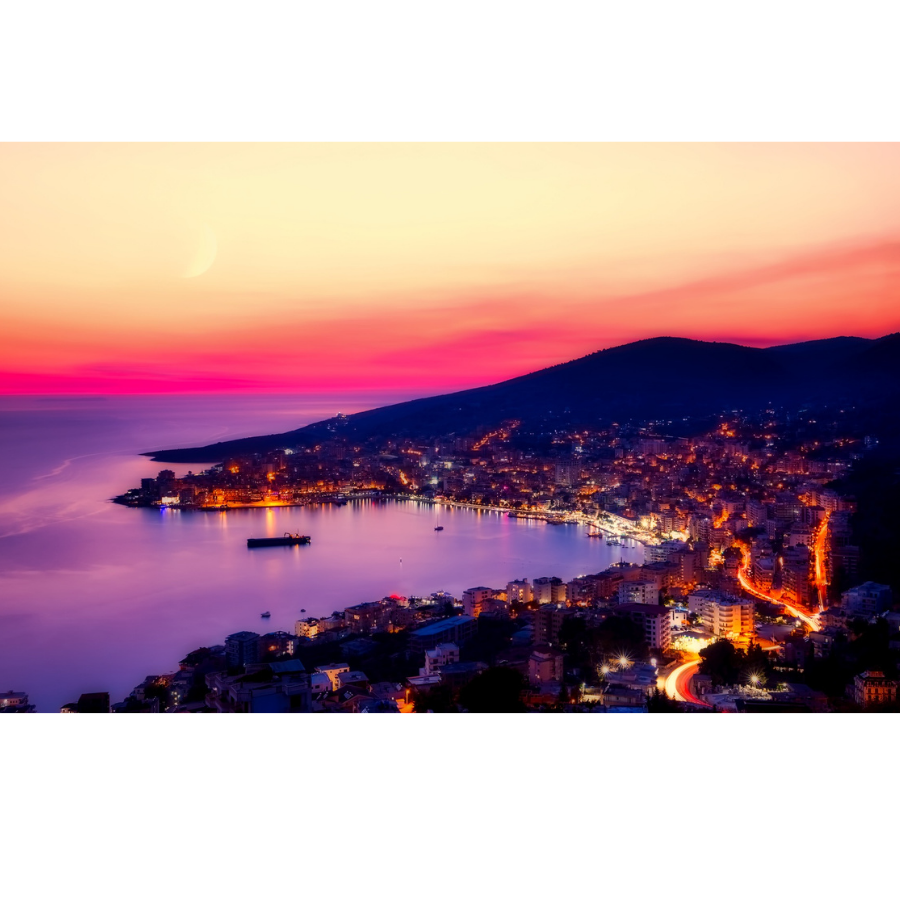
Sarandë is the Riviera's main urban hub — a proper town of around 50,000 people with a long promenade, a bustling restaurant scene, ferries running to Corfu (just 45 minutes across the water), and a domestic airport with seasonal connections to Tirana and beyond. Corfu is so close that on a clear day you can see cars moving along its coast road. Sarandë is more of a base than a destination — stay here for the convenience, logistics, and evening life, and use it as a launchpad for Ksamil, Butrint, and the beaches to the north.

Ksamil
Ksamil is, for many visitors, the jewel of the Albanian Riviera — and it is not hard to see why. The small village sits just a short drive south of Sarandë, and its beaches are fronted by three small islands just offshore, all within easy swimming distance. The water here achieves that impossible Caribbean shade of turquoise that photographic evidence suggests but the eye finds hard to believe until it is standing in it. Ksamil is also the closest point on the Riviera to the ancient ruins of Butrint, a UNESCO World Heritage Site just a few kilometres away. The combination of extraordinary beaches and world-class archaeology in a single afternoon is hard to beat anywhere in Europe.
Beach comparison chart
Planning which beaches to prioritize? The chart below rates seven major beaches on the Riviera across three key criteria: water clarity, crowd level, and available facilities. Lower crowd scores mean fewer people — better for solitude.

Where to stay
Accommodation on the Albanian Riviera runs a wide spectrum, from bare-bones guesthouses run by local families to genuinely stylish boutique hotels with sea views and proper restaurant kitchens. The key is to match your accommodation choice to your priorities.
Budget travellers will do best in family-run guesthouses, which are abundant in every town from Dhermi to Sarandë. Expect to pay between 2,500 and 4,000 ALL (€23–37) for a double room with breakfast included in shoulder season, rising to around 5,000–6,000 ALL in peak July and August. Most guesthouses are family-run, breakfast is usually included, and the hosts are almost invariably excellent sources of local knowledge about which beach is best on which day.
Mid-range and boutique options have multiplied significantly in recent years. Dhermi has the most concentration of design-conscious hotels, some with infinity pools overhanging the sea cliffs, others in converted stone houses in the old village. Sarandë has a broader selection of professionally run hotels catering to the ferry crowd from Corfu. Ksamil has numerous small hotels and villa apartments within walking distance of the water. Prices for a good mid-range double room range from 6,000 to 12,000 ALL (€55–110) in peak season.
For the most immersive experience, consider splitting your stay: a few nights in the peaceful hilltop setting of Qeparo or Himara's old castle town, and a few nights at the beach in Dhermi or Ksamil. This captures both the cultural and the coastal character of the Riviera in a single trip.
What to eat
The Albanian Riviera's food scene is one of its less-discussed pleasures — and one of the best arguments for choosing it over the more expensive competitors across the water. The combination of the Ionian Sea on your doorstep, mountains full of herbs and wild greens behind you, and a culinary tradition that treats fish with straightforward respect produces some outstanding meals at prices that feel slightly surreal by Western European standards.
The default order at any Riviera taverna is peshk i grirë — grilled fish — typically a whole sea bream or sea bass cooked over wood coals and served with lemon, olive oil, and a wedge of fresh bread. A full fish meal for two, including a salad, bread, and a carafe of local white wine, rarely exceeds 3,000–4,000 ALL (€28–37). Mussels are farmed locally and abundant: ask for midhje të skuqura (fried mussels) or midhje në avull (steamed mussels with garlic). Octopus grilled over charcoal, a distinctly Ionian preparation, appears on most menus and should be ordered without hesitation.
Beyond seafood, look for fergese (a rich stew of peppers, tomatoes, and curd cheese), freshly baked byrek (flaky pastry filled with spinach, cheese, or meat), and the Albanian answer to Greek salad — tomatoes, cucumber, and mild white cheese in olive oil. Local olive oil from the groves you see running down to the sea is excellent and often sold direct by producers in the villages.
Beach tavernas operate on a mostly cash basis. Budget around 800–1,200 ALL per person for a generous lunch including drinks; a full dinner with fish, wine, and dessert at a sit-down restaurant in Himara or Sarandë will run 1,500–2,500 ALL per person. Restaurant quality is high and prices are low in ways that continue to surprise visitors expecting Greek-level costs.
Best time to visit
The Riviera's swimming season runs from roughly early June through the end of September, with sea temperatures peaking in August and the warmest evenings in July and August. That said, the timing of your visit matters considerably for the kind of experience you have.
May and October offer the best combination of value, peace, and pleasant weather. Temperatures in May reach the low-to-mid twenties, the sea is cool but swimmable, and the beaches are largely empty — local life is entirely normal around you. October is arguably even better for those who don't need the warmest water: air temperatures stay in the low twenties, the sea retains summer warmth, and the tourist infrastructure is still open while the crowds have gone home.
June is a sweet spot for beach lovers who want warm water, manageable crowds, and full access to beach bars and restaurants without the extreme prices and packed sands of high summer. July and August are peak season: hot, busy, expensive (by Albanian standards), and booked out in advance for the best accommodation. If you must travel in this window, book early and arrive at the beaches before 10:00 to secure a good spot. September shares much of June's appeal — still warm, crowds beginning to thin from mid-month onwards, prices softening.
Practical tips for the Albanian Riviera
Carry cash. Albania is a predominantly cash economy, and smaller beaches, roadside tavernas, and family guesthouses often do not accept cards. ATMs are readily available in Sarandë, Himara, and Dhermi, but can be scarce or unreliable at smaller settlements. Carry enough Albanian lek to cover a day or two of spending before you leave each town.
Beach chair rental runs approximately 500–1,000 ALL (€4.50–9) per chair per day on organised beaches. At quieter spots like Borsh and Palasë you can often spread a towel on the pebbles for free. Umbrella rental is typically bundled with chairs.
Bring snorkelling gear. The clarity of the Ionian water along the Albanian coast means snorkelling here is genuinely special — particularly around the rocky headlands near Ksamil's islands and at Gjipe. You can rent masks and fins at some beach bars in Dhermi and Ksamil, but quality is inconsistent. Packing your own is worth the bag space.
Driving the SH8 requires care and patience. The coastal road is single-carriageway for much of its length, with hairpin bends, occasional fallen rock debris, and Albanian drivers who use the horn as their primary navigational instrument. Do not rush, especially on the Llogara descent. In summer, afternoon traffic heading back north towards Tirana can create significant delays on the pass — leaving the coast by mid-afternoon is advisable if you have a time constraint.
Language: English is widely spoken in tourist areas and by younger Albanians. A few words of Albanian — faleminderit (thank you), mirëdita (good day), sa kushton (how much?) — will be greeted with genuine warmth. Italians and Greeks will find their languages surprisingly useful, given Albania's historical connections to both.
Butrint is not optional. If you are staying in Ksamil or Sarandë, the ancient archaeological site of Butrint — a UNESCO World Heritage Site encompassing Greek, Roman, Byzantine, and Venetian layers of civilization in one remarkably beautiful setting — is a 25-minute drive away and absolutely deserves a half-day. Entrance is around 700 ALL. Combine it with a morning swim at Ksamil and a long lunch in Sarandë for a perfect Riviera day.
Planning a trip to the Albanian Riviera?
Browse verified hotels, restaurants, and tour operators in Sarandë and along the Riviera.
Browse Sarandë listings →